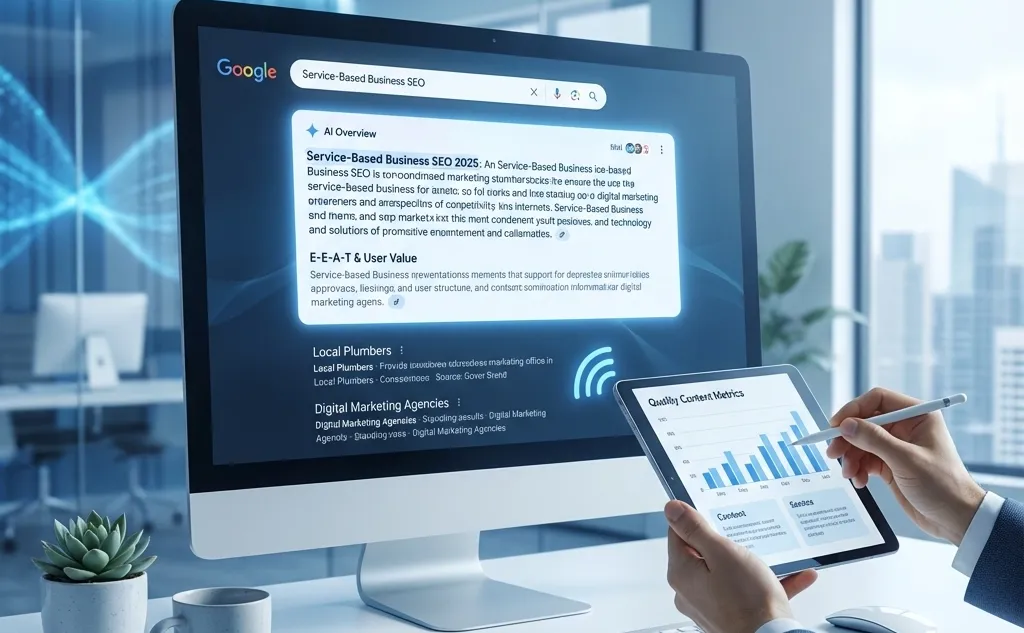
If you've been wondering why your perfectly optimized content isn't driving the traffic it used to, you're not imagining things. Google's AI Overviews have fundamentally restructured how search works, and frankly, most service-based businesses are still playing by 2023 rules in a 2025 game.
As someone who's been helping service businesses navigate digital marketing shifts for years, I can tell you this isn't just another algorithm update, it's a complete paradigm shift. Your content is no longer competing for clicks; it's competing to be the authoritative source that AI systems cite when answering your prospects' questions.
Let's start with the numbers that should grab your attention. AI Overviews appeared for just 10% of U.S. desktop keywords back in March 2025. By September? That number jumped to 30%. We're talking about nearly one in three searches now generating AI-powered summaries instead of traditional blue links.
These overviews are reaching 1.5 billion users monthly across more than 200 countries. If your service-based business relies on organic search visibility, and let's be honest, most of us do, you can't afford to ignore this shift.
Here's where it gets interesting (and slightly terrifying). Top-ranking organic results are losing between 24% and 45% of their traffic when AI Overviews appear, particularly for informational queries. Click-through rates for the #1 organic position have dropped from 5.6% to 3.1%.
But before you panic, there's a crucial nuance here. While total clicks are declining, the quality of remaining clicks is actually improving. Users who do click through are more engaged, spending more time on sites, and showing higher conversion intent.
What does this mean for your HVAC company, marketing agency, or consulting practice? The days of casting a wide net with generic content are over. You need to be laser-focused on creating content that either gets cited by AI or attracts the right prospects when they're ready to take action.
Think about how your prospects used to find you. They'd search "digital marketing strategies," browse through multiple articles, compare different perspectives, and eventually contact someone. Now, Google's AI reads all those articles, synthesizes the information, and presents a comprehensive answer directly in the search results.
Your content isn't the destination anymore, it's the raw material AI systems use to build better answers. This completely changes how we approach content strategy for service businesses.
Instead of optimizing for "how to rank #1 for marketing automation," we need to optimize for "how to become the go-to source AI systems reference when discussing marketing automation implementation."

The Italian market, which has had AI Overviews since February 2025, gives us a preview of what works. General information sites saw 30-40% traffic drops, but hyper-specialized content, expert blogs, technical deep-dives, and educational platforms, saw visibility increases of 15-45%.
Here's what this means for your content strategy:
Specialized Depth Over Surface Coverage
Stop trying to be Wikipedia. Instead of writing comprehensive guides that cover everything about a topic, create multiple focused pieces that address specific aspects with genuine expertise. If you're a business consultant, don't write "The Complete Guide to Business Strategy." Instead, create separate deep-dives on competitive analysis frameworks, market positioning methodologies, and implementation planning processes.
Structured, Extractable Information
Google's AI prefers content it can easily digest and repurpose. This means clear hierarchies, defined sections, and information architecture that makes your expertise extractable. Use descriptive headings, bullet points, numbered lists, and logical flow that an AI system can follow and reference.
Real Question-Based Content Creation
Here's where service businesses have a massive advantage. You talk to clients every day. You know the actual questions prospects ask, not what keyword tools suggest they might ask. Mine your sales conversations, support tickets, and client onboarding sessions for content ideas.
When someone calls asking about PPC management, they're not really asking "what is PPC management?" They're asking "how do I know if my current PPC spend is actually driving qualified leads?" Create content around those real questions.
Traditional SEO focused on ranking for specific keywords. GEO, Generative Engine Optimization, focuses on how AI systems understand and connect topics across your content ecosystem.
For service businesses, this means creating interconnected content that demonstrates authority across your entire service offering. If you provide IT consulting, you might need content covering network security assessments, cloud migration planning, compliance frameworks, and disaster recovery, each piece comprehensive enough to stand alone, but connected so AI systems recognize your expertise across the full IT consulting landscape.

Step 1: Audit Your Current Content Through an AI Lens
Look at your existing content and ask: "If an AI system were building an answer about [your service area], would it cite this piece as authoritative?" If the answer is no, you've got work to do.
Step 2: Identify Your Authority Pillars
Map out the 3-5 core areas where you want AI systems to recognize you as an expert. For a marketing agency, this might be SEO strategy, PPC management, content marketing, and marketing automation. Create content clusters around each pillar.
Step 3: Optimize for Citability
Structure your content so key insights, methodologies, and data points are easy for AI systems to extract and reference. Use clear attribution, cite your sources, and present information in logical, digestible chunks.
Step 4: Create Progressive Content Journeys
Since search is becoming more conversational, with users asking follow-up questions, create content that allows progressive deepening. Your initial piece might cover "How to Choose Marketing Automation Software," with linked pieces diving into "Integration Requirements for Marketing Automation" and "ROI Measurement Frameworks for Marketing Tech."
Traditional metrics like keyword rankings and organic traffic volume don't tell the complete story anymore. We need to track:

Here's what most of your competitors don't understand yet: this shift actually creates massive opportunities for service businesses willing to adapt. While everyone else is panicking about traffic drops, you can be building the kind of authority that gets embedded into how AI systems understand your industry.
The businesses that master this transition won't just rank well: they'll become the default expert references in their fields. That's a fundamentally more durable competitive advantage than any traditional SEO ranking.
At Ideation Digital, we're already helping our clientsoptimize their content strategyfor this new reality. The key is understanding that we're not just adapting to an algorithm change: we're positioning for the future of how people find and evaluate service providers.
The question isn't whether AI Overviews will continue expanding: they will. The question is whether you'll be the expert source AI systems turn to when your ideal prospects are looking for solutions, or whether you'll be wondering why your perfectly optimized content isn't driving results anymore.
The businesses that figure this out first won't just survive the transition( they'll dominate it.)